> ## Documentation Index
> Fetch the complete documentation index at: https://docs.luklak.com/llms.txt
> Use this file to discover all available pages before exploring further.
# The Build Layer: Luklak's 3-Tier Architecture
> A deep dive into Luklak's 3-Tier Architecture: the Core Blocks, Function Design, and Usage & Operation layers that allow you to build any business system.
## Why This Matters
Traditional business software creates invisible walls between departments. Sales data is trapped in a CRM, project updates are lost in a separate tool, and customer feedback sits isolated in another. This friction slows you down, creates data silos, and prevents your teams from working as a unified force.
Luklak is fundamentally different. It's not a collection of apps—it's a single, universal foundation for building your company's entire operating system. The Build Layer is where this happens, using a powerful 3-Tier Architecture.
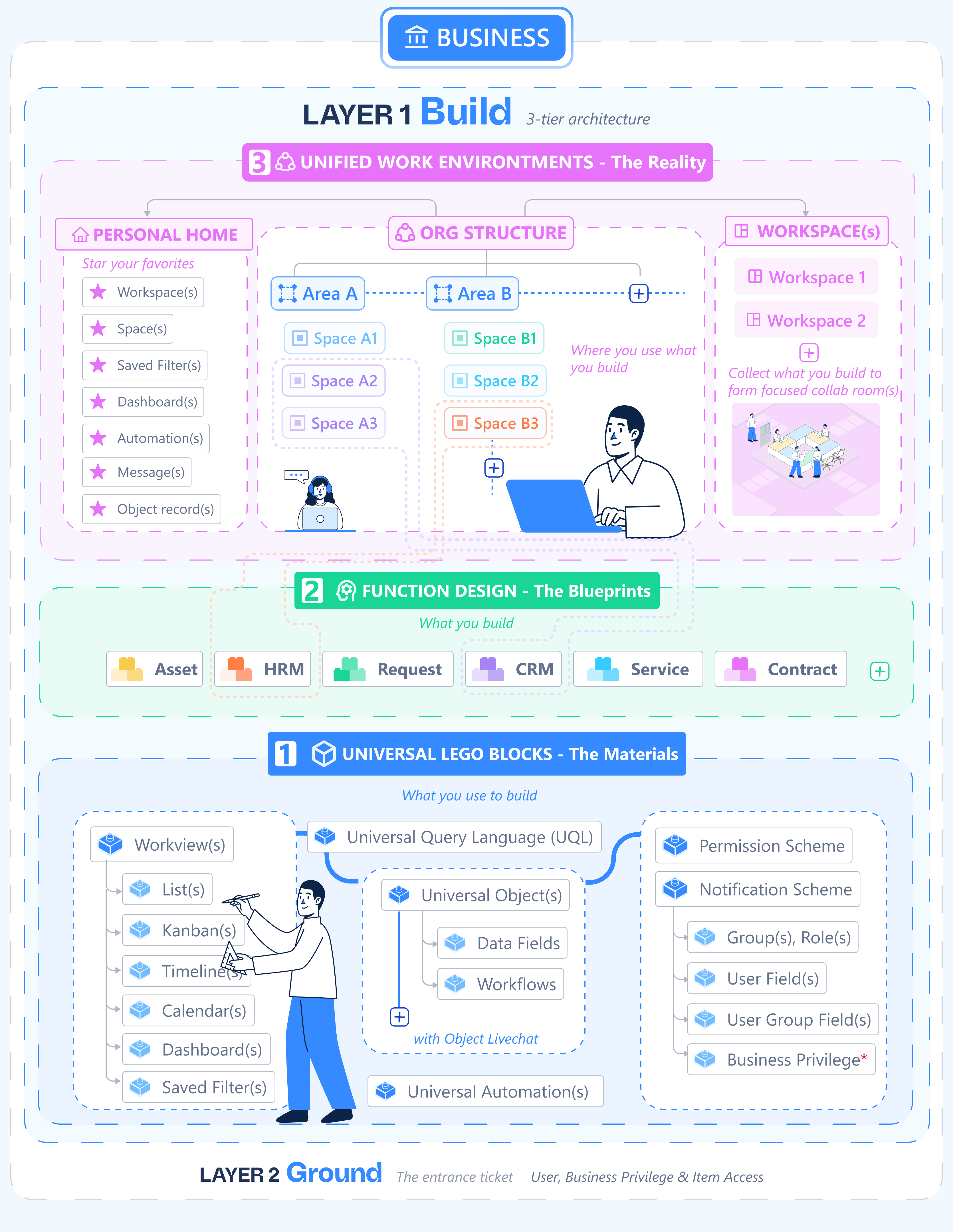 ## The 3 Tiers of Construction
This model provides a structured way to think about building and using your solutions, moving from raw materials to a design blueprint, and finally to a live application.
This is the foundational layer of building—the universal "LEGO pieces" that all business processes are made from. This includes our 9 universal components which provide ultimate flexibility:
* **`🧊 Universal Object`**: The core logical unit for any business entity.
* **`Workflow`**: Defines the statuses and transitions to model a process.
* **`Data Fields`**: Custom fields to capture all necessary information.
* **`Workviews`**: Customizable visual layouts (List, Kanban, etc.) for managing Objects.
* **`Universal Query Language (UQL)`**: A system for querying all data across the platform.
* **`Universal Automation`**: The platform-wide engine that connects and automates any process.
* **`Object Connection`**: The system for creating powerful relationships between Objects.
* **`Unified Live Chat`**: An integrated, three-tiered communication system.
* **`Permission & Notification Schemes`**: Fine-grained access control and alert systems.
This is the design layer. Here, you assemble the Core Blocks into no-code blueprints called `📋 Functions`. A `📋 Function` is a complete, reusable operational plan for a specific process, like a sales CRM or a project management system. It packages the specific `Object Types`, workflows, automations, and permissions required.
This is the live application layer where work actually happens. When you deploy a `📋 Function`, it becomes one or more live `⏹️ Spaces`. This tier includes three key ways to organize and interact with work:
* **Organizational Structure**: The official hierarchy of `📂 Areas` and `⏹️ Spaces` that forms the unified structure for the entire company.
* **Workspaces**: A flexible command center, mainly for managers, to pull together various `⏹️ Spaces` and reports into a single, personalized view.
* **Personal Home**: An automatically aggregated "to-do" list for every individual, collecting all their assigned `🧊 Objects` and updates from across the platform.
This architecture allows for both incredible flexibility in design (Tier 2) and complete consistency in operation (Tier 3), all built upon a single, unified foundation of Core Blocks (Tier 1).
### What's Next?
* [**Explore the raw materials → Dive into the Tier 1 Core Blocks**](/en/02-platform/platform-overview/core-concepts)
* [**Learn to design blueprints → Go to the Function Design Playbooks**](/en/03-build/introduction)
* [**See how teams work → Explore Tier 3: Usage & Operation Guides**](/en/02-platform/use-and-operate)
## The 3 Tiers of Construction
This model provides a structured way to think about building and using your solutions, moving from raw materials to a design blueprint, and finally to a live application.
This is the foundational layer of building—the universal "LEGO pieces" that all business processes are made from. This includes our 9 universal components which provide ultimate flexibility:
* **`🧊 Universal Object`**: The core logical unit for any business entity.
* **`Workflow`**: Defines the statuses and transitions to model a process.
* **`Data Fields`**: Custom fields to capture all necessary information.
* **`Workviews`**: Customizable visual layouts (List, Kanban, etc.) for managing Objects.
* **`Universal Query Language (UQL)`**: A system for querying all data across the platform.
* **`Universal Automation`**: The platform-wide engine that connects and automates any process.
* **`Object Connection`**: The system for creating powerful relationships between Objects.
* **`Unified Live Chat`**: An integrated, three-tiered communication system.
* **`Permission & Notification Schemes`**: Fine-grained access control and alert systems.
This is the design layer. Here, you assemble the Core Blocks into no-code blueprints called `📋 Functions`. A `📋 Function` is a complete, reusable operational plan for a specific process, like a sales CRM or a project management system. It packages the specific `Object Types`, workflows, automations, and permissions required.
This is the live application layer where work actually happens. When you deploy a `📋 Function`, it becomes one or more live `⏹️ Spaces`. This tier includes three key ways to organize and interact with work:
* **Organizational Structure**: The official hierarchy of `📂 Areas` and `⏹️ Spaces` that forms the unified structure for the entire company.
* **Workspaces**: A flexible command center, mainly for managers, to pull together various `⏹️ Spaces` and reports into a single, personalized view.
* **Personal Home**: An automatically aggregated "to-do" list for every individual, collecting all their assigned `🧊 Objects` and updates from across the platform.
This architecture allows for both incredible flexibility in design (Tier 2) and complete consistency in operation (Tier 3), all built upon a single, unified foundation of Core Blocks (Tier 1).
### What's Next?
* [**Explore the raw materials → Dive into the Tier 1 Core Blocks**](/en/02-platform/platform-overview/core-concepts)
* [**Learn to design blueprints → Go to the Function Design Playbooks**](/en/03-build/introduction)
* [**See how teams work → Explore Tier 3: Usage & Operation Guides**](/en/02-platform/use-and-operate)